


PulseWatch Wrist Blood Pressure Monitor
Don't memorize
the numbers.
Read the colour.
One touch on a bare wrist. Two seconds later you get systolic, diastolic, pulse — and a red, amber or green bar that tells you where the reading sits before you've finished looking at it. Spoken aloud, if you want it.
PulseWatch Wrist Blood Pressure Monitor
- Three-colour range indicator — know the reading at a glance
- Spoken results, switchable on or off
- 100+ readings per charge — no batteries, ever
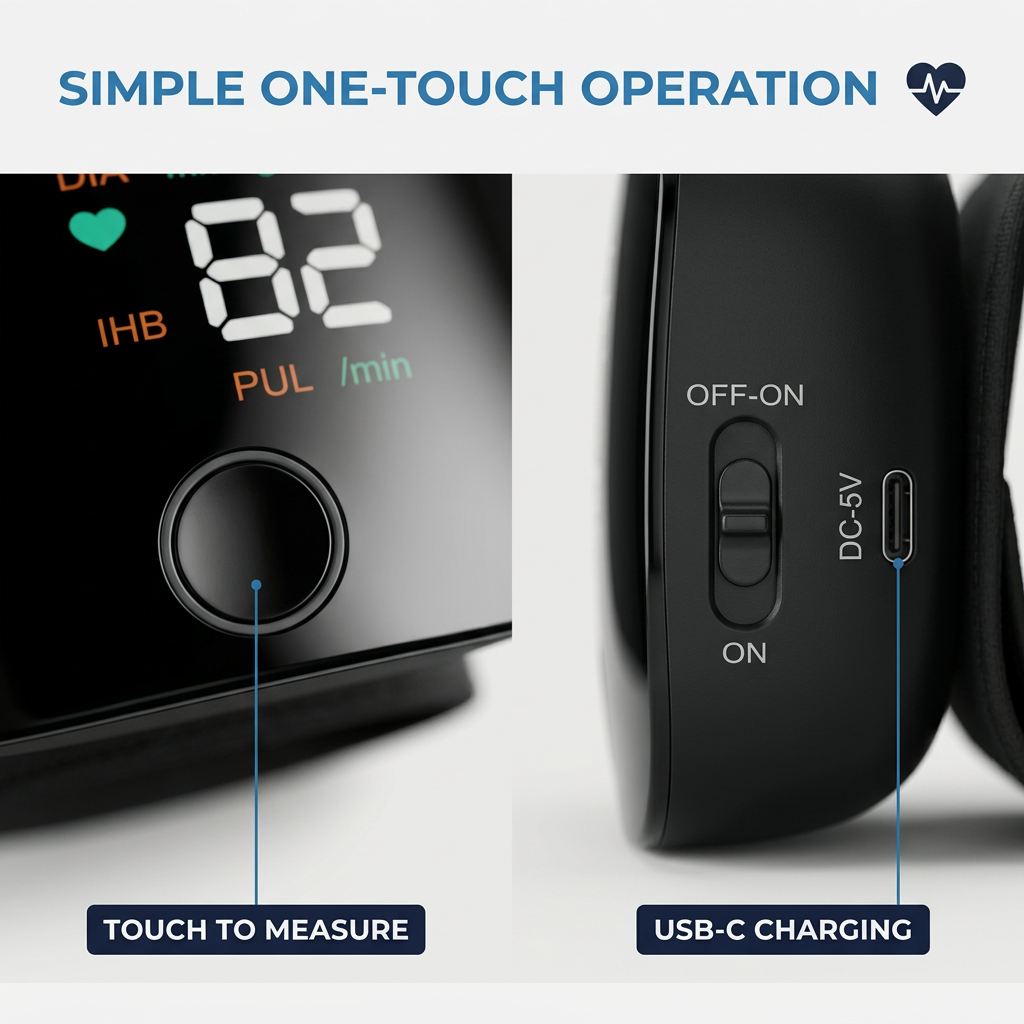
- Sealed one-piece body with flush touch control
Press once.
That's the manual.
No wheel to spin, no mode to select, no plunger button to hunt for with your other hand. The entire interface is one flush circle you touch with a thumb.
You took the
reading. Now what?
“138 over 86.
…Is that bad?”
That pause is the actual problem. Not the measuring — the not-knowing. Most people can't recall the thresholds under pressure, so the number gets taken, doubted, and forgotten. PulseWatch answers it structurally: a red, amber and green column sits beside the digits and a marker lands in one of them. You read the position before you read the number.
Bright enough
at 6am.
An emissive display, not a grey LCD you have to angle toward a lamp. White digits at full contrast, colour reserved strictly for what the reading means — never for decoration.
Built like an
instrument.
Flush capacitive touch
No rubber dome, no travel, no click. A recessed circle you tap with a thumb — nothing to press hard against your own wrist while you're trying to stay still.
Three-colour range column
Red, amber, green, with a marker that lands in one of them. The interpretation happens on the device instead of in your head at 6am.
It says the reading out loud
So someone with tired eyes can check their own pressure, in their own chair, without handing the device to anybody. Switchable off when you'd rather it stayed quiet.
Sealed rechargeable body
Over 100 readings per charge from any 5V/1A phone charger or power bank. No battery door to break, no drawer full of AAAs, no dead device on the morning you need it.
Hear it
for yourself.
The voice readout is the feature you can't judge from a photograph. Tap play — audio comes on instantly — and listen to a full reading being announced.
Position is
accuracy.
Here's the honest version, because you'll find it the moment you search: wrist readings are sensitive to placement, and a wrist held below the heart reads high. That isn't a defect, it's physics — and it's the reason most wrist-monitor complaints exist. Three habits remove almost all of it.
Bare wrist, snug cuff
Skin only — never over a sleeve. Cuff sits about a finger's width below the base of your palm, firm enough that it doesn't slide.
Wrist level with your heart
Elbow on a table, hand relaxed, palm turned toward your chest. This single adjustment accounts for most of the variance people blame on the device.
Same chair, same time, still
Feet flat, back supported, two quiet minutes first, no talking during. Blood pressure moves all day — you're looking for a trend, not a verdict.
Learn your own offset
Take PulseWatch to your next appointment and read it against the cuff in the room. If your wrist runs consistently a few points high or low, now you know by how much — and every reading afterwards is worth more. Clinicians recommend exactly this for any home monitor.
Wraps like
a watch.
A soft woven cuff and a single-piece shell, closed one-handed. Nothing to inflate manually, nothing to squeeze your upper arm until you brace against it — which is why most arm cuffs end up in a drawer.
The whole
sheet.
No asterisks, no "up to". If it isn't listed here, we don't claim it.
- Measurement site
- Wrist — radial artery
- Values displayed
- Systolic · Diastolic · Pulse
- Range indication
- 3-colour column
- Irregular heartbeat
- IHB indicator
- Audio readout
- Yes — switchable
- Power
- Internal rechargeable cell
- Charging input
- DC 5V — any 5V/1A adapter
- Readings per charge
- 100+
- Finishes
- Piano Black · Rose
- Cuff circumference
- ⟨CONFIRM⟩
- Stored readings
- ⟨CONFIRM⟩
- Warranty
- ⟨CONFIRM⟩
Charge it
every few weeks.
Plug it into the same charger as your phone, or a power bank on a hotel nightstand. Over 100 readings between charges means most people top it up about as often as they change a toothbrush head.
Before
you ask.
Are wrist monitors as accurate as an arm cuff?
We'll give you the real answer rather than the marketing one. For a single most-reliable measurement, clinical bodies generally point to an upper-arm cuff, and wrist devices are more sensitive to how you hold your arm. That's the honest trade-off.
What a wrist monitor wins on is the reading you'll actually take. A device used every morning tells you far more than a precise one that stays in a cupboard because the arm-cuff squeeze is unpleasant. Follow the three positioning habits above, compare once against the cuff at your doctor's office to learn your personal offset, and you have a genuinely useful daily record.
Will it fit my wrist?
The cuff fits wrists from ⟨CONFIRM RANGE⟩. Measure around your wrist just below the palm with a tape or strip of paper before ordering. Wrist cuffs suit a wider spread of body sizes than upper-arm cuffs, which is often the deciding factor for larger-armed users.
Can I turn the voice off?
Yes. The audio readout is a setting, not a permanent feature. Leave it on for hands-free results, switch it off if you'd rather your reading stayed between you and the display.
Do I need to buy batteries?
Never. The cell is built into the sealed body and recharges through the DC-5V port from any standard 5V/1A phone charger or USB power bank. A 5V/1A source gives the best result — avoid fast-charge bricks rated well above that.
Is it easy enough for someone who isn't good with gadgets?
There's one control on the entire device. Wrap the cuff, touch the circle, wait, read the colour. No app, no account, no pairing, no menus. With the voice readout on, they don't even need to see the screen.
How well does it hold up?
The shell is a single sealed piece — no battery hatch, no mechanical push-button, which removes the two parts that fail first on cheap monitors. The cuff is woven textile, wipeable with a dry cloth. Keep it out of water and away from direct heat. Warranty: ⟨CONFIRM⟩.
Shipping and returns?
Orders leave our warehouse in ⟨CONFIRM⟩ and arrive in ⟨CONFIRM⟩, tracked. Returns accepted within ⟨CONFIRM⟩ days. If it doesn't fit your wrist or you can't get on with it, send it back.
Does this replace seeing a doctor?
No, and any brand that implies otherwise is one to walk away from. PulseWatch is for awareness and record-keeping. It doesn't diagnose anything and it doesn't decide your treatment. What it does is get you to your appointment with weeks of real readings instead of a single number taken in a waiting room. Never change or stop medication based on a home reading.
Morning.
Same chair.
Consistency is what makes a home reading worth anything. Same time, same seat, same posture — the device is small enough and quiet enough to become part of the routine instead of an event.
What people
report.
The best monitor
is the one
you'll actually use.
One touch. Two seconds. One colour.
PulseWatch is a home monitoring device intended for personal awareness and record-keeping. It does not diagnose, treat, cure or prevent any condition and is not a substitute for professional medical assessment. Readings vary with posture, position, time of day and activity. Discuss your readings — and any change to medication — with a licensed clinician. Not for use in a medical emergency.